


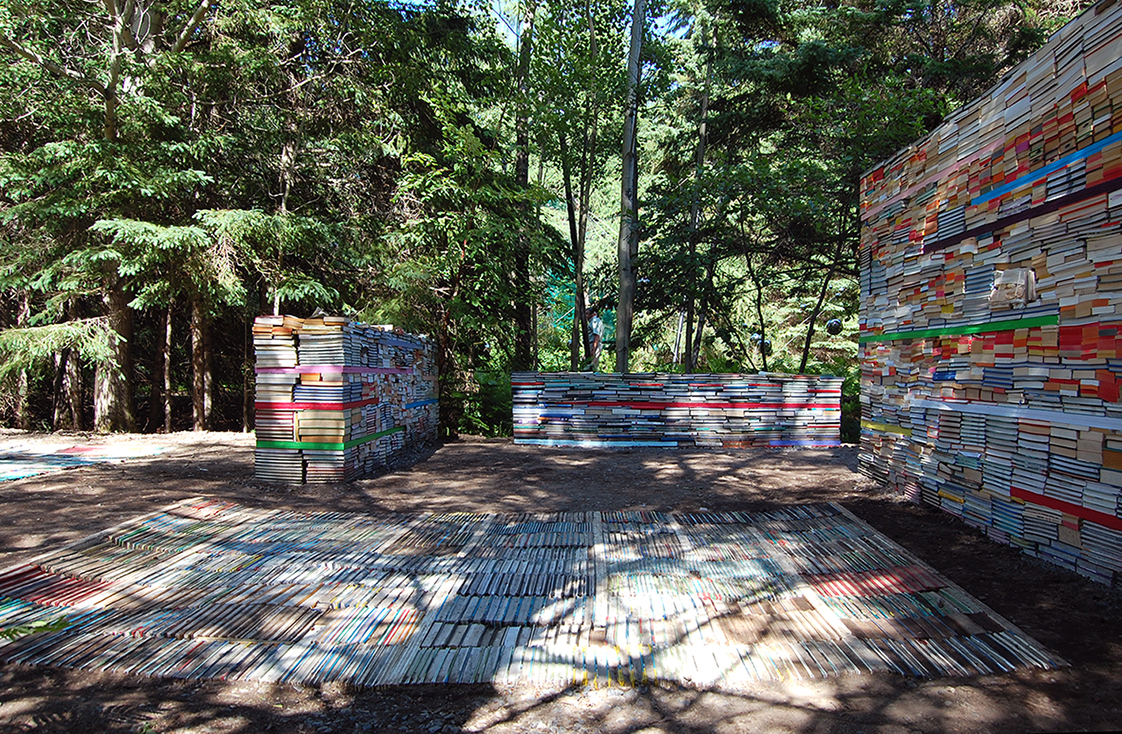
Plug In Institute of Contemporary Art is pleased to present:
Summer Institute 2025: Magic Creek
led by faculty Rodney LaTourelle and Louise Witthöft
August 11 – 21, 2025
Established in 2009, The Summer Institute is a free, international artist research program for professional artists and cultural workers in all disciplines and media. Each year, we invite artists that are critically leading conversations in their field to lead a two week Summer Institute. Each iteration of the Summer Institute invites participants to expand upon their own interests and projects and includes opportunities to work in a collaborative peer-to-peer environment through group activities, guest lectures, and workshops.
This year’s iteration of the Summer Institute will be led by Rodney LaTourelle and Louise Witthöft. It will run from August 11 to August 21, 2025. Each day of the Summer Institute begins with a collective “Story Time” – a shared reading that grounds us in terms of visibility, care, interconnection, and resistance. These sessions set the tone for the day, offering poetic, political, and philosophical entry points into the week’s activities. Throughout the program, we will be joined by invited special guests that expand on our discussions through creative work and physical experience. Participants will further have the unique opportunity to work in creative ways with salvaged materials, such as old concrete, bricks, and glass, from the former Hudson’s Bay Company building, which is situated across the street from the gallery and currently undergoing renovation by the Southern Chiefs Organization. Further working in collaboration with the workshop at the Centre for Architectural Structures and Technology, University of Manitoba, recycled materials will undergo artistic transformations, such as through molding, casting, and concrete-forming, enabling embodied discussions around the HBC’s extensive colonial legacy with an opportunity for awareness and critique. The Summer Institute will conclude with an Open Studio exhibition/performance at Plug In ICA featuring a collective landscape of cast and recycled objects. This shared process – of observing, collecting, moulding, and casting – becomes a way to engage with unseen systems, contested histories, and sustainable futures, in both material and metaphor.
Faculty
Rodney LaTourelle and Louise Witthöft are a project-based artist duo known for their large-scale immersive installations that explore the spatial poetics of communal experience. Exhibiting internationally for over twenty years, their interdisciplinary work often engages infrastructure as an expressive tool and is in the collections of The National Gallery of Canada, Remai Modern, and the Art Gallery of Ontario.
Guest Faculty
Jaimie Isaac
KC Adams
Kevin Stafford
Ala Roushan
Charles Stankievech
Participants
Juca Aquino is a Brazilian-Canadian artist living and working in Winnipeg, Manitoba, Canada. Fascinated by how error can generate unexpected results, Juca embraces mistakes, whether it’s a brushstroke, a software glitch, or a printing mishap. Juca has exhibited work at La Maison des artistes, Martha Street Studio and the School of Art Student Gallery.
Gabriel Bell-Gam is a Nigerian-born digital curator, cultural worker, and founder of the Bell-Gam Digital Cultural Heritage Center. His interdisciplinary practice focuses on preserving African cultural heritage through emerging technologies such as photogrammetry, 3D modeling, and immersive media.
Bell-Gam leads the Silent Heritage Project, a long-term initiative documenting intangible cultural practices and architectural memory in the Opobo Kingdom and other communities across southern Nigeria. Currently based in Winnipeg, Bell-Gam is pursuing an MA in Cultural Studies (Curatorial Practices) at the University of Winnipeg.
His work engages themes of memory, identity, postcolonial archives, and cultural restitution, often operating at the intersection of community storytelling and digital preservation. Through exhibitions, fieldwork, and research, he aims to create accessible pathways for heritage engagement across continents.
Betty Carpick is an artist, environmentalist, and educator. The ways that she creates and offers stewardship are shaped by her Cree and Eastern European heritage and growing up in northern Manitoba. Carpick’s practice includes ink making, textile arts, writing, drawing, sculpture, photography, performance, and installation. Many times, there’s not a distinct line between disciplines. Carpick’s practice dovetails with community-engaged art projects with all ages, abilities, and backgrounds. To strengthen relationships and reciprocity, she invites interdisciplinary interactions to amplify the spirit of play, discovery, and collective responsibility for our planet. Carpick lives in Thunder Bay, Ontario.
Cameron Forbes’s practice engages with public and built environments to observe socio-cultural relationships with nature. In 2024, Forbes joined USask’s School for the Arts as an Assistant Professor in Painting and Drawing, coming from a similar position at Grenfell Campus, Memorial University, Corner Brook/Elmastukwek, Newfoundland (2017-2023). She holds a BFA from NSCAD University (Halifax) and a MFA from Concordia University (Montreal). From 2008-2011, Forbes was the executive director of Winnipeg’s Art City. Of settler descent, Forbes was born in Regina, Saskatchewan, Treaty 4 Territory. She lives in Saskatoon with her partner and three children.
Helga Jakobson is a transdisciplinary artist living on Treaty One Territory. In 2017, she received an MFA from AKV St. Joost (The Netherlands) and Transdisciplinary New Media program at the Paris College of Art (France). She has exhibited and participated in residencies across Canada and Europe. She often works within the realm of new media, with a particular affinity for sound as medium. Lately her research has centred around the sixth mass extinction that we are living in, as well as how to live on a damaged earth and how to make tangible the almost invisible and inaudible losses that are occurring all around us.
Phil Koch: While working as an editor, writer, photographer, and in other capacities for cultural publications including magazines, journals, books, and newspapers, Phil Koch has maintained an engagement with research involving art, architecture, and other “humanities” disciplines. These studies have involved interdisciplinary approaches to economy and exchange, along with questions of discipline and interdisciplinarity as they relate to what might become of the humanities — concerning the production of texts as well as photographic practices, installations, public art, material form, and other media. Critical and theoretical approaches are explored, including as they encounter and might be challenged by contemporary and historical objects and environments.
Gaëlle Legrand lives and works between Tiohtià:ke (Montréal, Canada) and her native village Magnicourt-en-Comté, in northern France. Currently completing her BFA in Sculpture at Concordia University, she recently exhibited at the Art Mur Gallery (Fresh Paint/New Construction, July 2024), the Soft Square Gallery (Aporia, April 2024) and the VAV Gallery (Komorebi, March 2024). She also just completed a field school residency at the Monteverde Institute in Costa Rica and a one-week residency at Domaine des Lignes, in Woburn, Québec. Legrand is currently a research fellow at Post Image Lab at Concordia University and is the recipient of several grants and scholarships, such as the FASA Special Project Grant.
Sierra MacTavish is an emerging new media artist based on the unceded territories of the xwməθkwəy̓ əm, Sḵwx̱wú7mesh, and səlilwətaɬ Nations (Vancouver, BC). Her work explores memory, perception, and place through distortion, using databending techniques to create glitched images and immersive audio-visual experiences. Recently, she has expanded her practice into experimental filmmaking, producing layered, atmospheric videos. Sierra’s work is deeply rooted in social engagement and community, informed by her involvement in creating accessible arts programming at Eastside Arts Society and grassroots organizing with Music Waste. She also contributes to arts advocacy through the BC Provincial Cultural Space Managers Network. Her practice brings together experimental media, place, and community.
Moneca Sinclaire is a Nehinan (Swampy Cree) sustainable artist originally from Northern Manitoba. Sinclaire learned her craft through their Nohkom (grandmother) who would turn candy wrappers in garland, make blankets, rugs, and baskets out of old clothes, and believed the “Earth has only so much room in her belly” and so “we must learn to use everything.”
Throughout her practice, Sinclaire has taken courses to learn more about other forms of art, such as mosaic, pottery, and book binding. She works with many different age groups from youth to senior folks demonstrating and teaching ways to use everyday objects to create exquisite works of art.
Tricia Wasney’s artwork is informed by the landscape, cartography and forgotten or hidden histories. She is interested in the cast-off, the ordinary and the every-day, investigating ideas through narrative jewellery and craft-based practices using reclaimed, thrifted and found materials almost exclusively. Her practice has recently evolved and expanded to larger sculptural and assemblage works though she continues to make intimate jewellery-based pieces. Both these approaches were made evident in Wasney’s exhibition in January 2025 at La Maison des artistes visuels in Winnipeg.
Wasney has participated in artist residencies in the Comox Valley, BC; Victoria Beach, MB; Athens, Greece; Riding Mountain National Park, MB; Churchill, MB and Belfast, Northern Ireland. Her work has been exhibited locally, nationally and internationally. Wasney has received numerous grants for her visual artwork and writing from The Canada Council for the Arts, the Manitoba Arts Council and the Winnipeg Arts Council.
Daisy Wu is a photo-based artist from Nantong, China, currently based in Winnipeg, Canada, on Treaty 1 Territory. She graduated from the University of Manitoba’s School of Art in 2023, where she was awarded an Undergraduate Research Award. In 2024, Wu participated in an Early Career Banff Residency at the Banff Centre of Arts and Creativity. Her work has recently been exhibited at MAWA and aceartInc as part of the FLASH photographic festival. Wu’s practice explores themes of family, belonging, and immigration through photography, installation, and video.
Acknowledgments
We are on Treaty 1 Territory. Plug In ICA is located on the territories of the Anishinaabeg, Cree, Oji-Cree, Dakota, and Dene peoples, and the National homeland of the Red River Métis. Our water is sourced from Shoal Lake 40 First Nation.
Plug In ICA would like to thank the Southern Chiefs’ Organization for their support on this project.
The 2025 Summer Institute is made possible through a generous contribution from Heritage Canada’s Canada Arts Training Fund.
Plug In ICA extends our heartfelt gratitude to our generous donors, valued members, and dedicated volunteers. We acknowledge the sustaining support of our Director’s Circle. You all make a difference.
We gratefully acknowledge the support of the Canada Council, the Manitoba Arts Council and Winnipeg Arts Council. We could not operate without their continued financial investment and lobbying efforts.
Plug In ICA relies on community support to remain free and accessible to all, and enable us to continue to present excellent programs. Please consider becoming a member of Plug In ICA and a donor at https://plugin.org/support or by contacting Gilles Hébert, Interim Executive Director at executivedirector@plugin.org.
For more information on public programming and exhibitions contact info@plugin.org.
For general information, please contact: info@plugin.org or call 1.204.942.1043